How systems stay coherent while the weather changes.
A beginner-friendly introduction to a five-field discipline that compares body, relationship, ecosystem, planetary, stellar, and cosmic systems without pretending they are all the same machine.
The short version
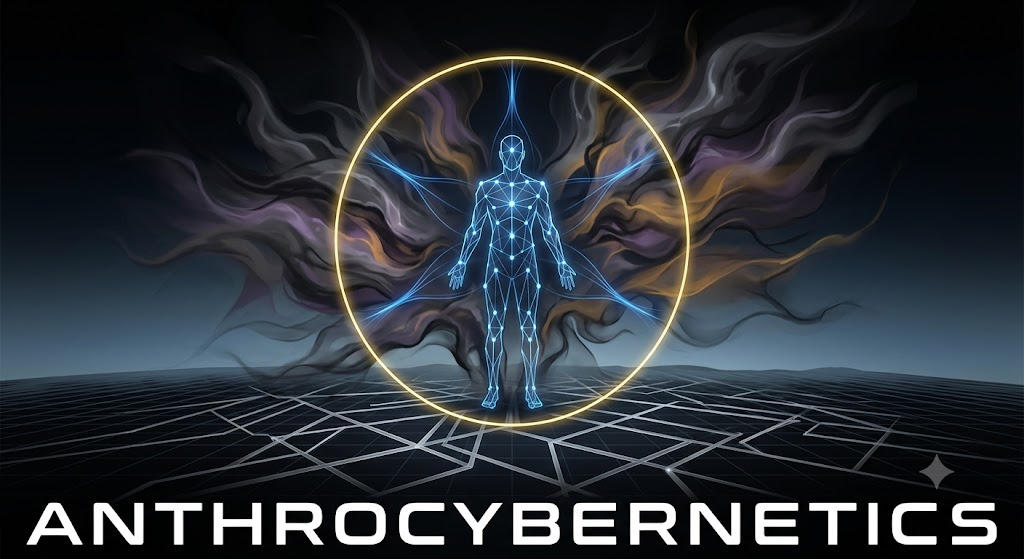
Anthrocybernetics studies how coupled systems synchronize, receive forcing, cross thresholds, preserve patterns, and route information across nested environments.
Five fields, five questions
Phase
coordinationAre the components timed well enough to function together? Think coupled oscillators, synchrony, and drift.
Field
forcingWhat surrounds and shapes the system? Think boundary conditions, inputs, and environmental pressure.
Arc
thresholdWhat crosses a threshold? A discharge, transition, rupture, ignition, or transformation.
Form
persistenceWhat pattern survives? A structure, memory, morphology, ritual, or stable configuration.
Lattice
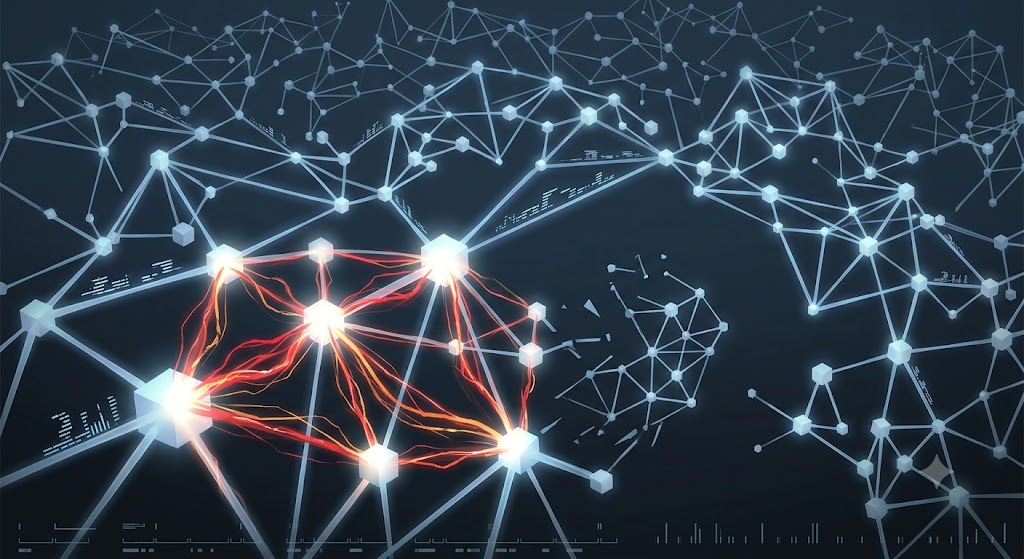
topologyHow does arrangement control flow? Networks filter, amplify, block, and redirect energy and information.
The cosmic-weather addition
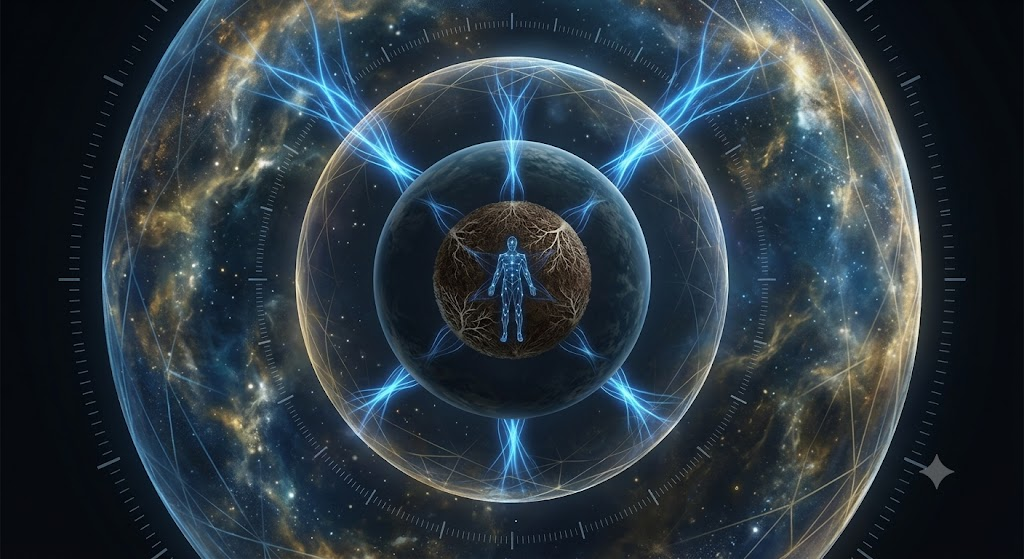
V3 adds five nested climate segments. “Climate” here means the changing energetic and boundary-condition environment of a system, not just temperature.
1 · Galactic macroclimate
Magnetic fields, cosmic rays, turbulence, and large-scale events set broad context.
2 · Local interstellar mesoclimate
The surrounding interstellar medium supplies the regional conditions through which neighboring astrospheres move.
3 · Stellar / astrospheric climate
A star’s wind, radiation, magnetic activity, and plasma bubble create a local stellar environment.
4 · Planetary climate
Magnetosphere, atmosphere, oceans, geology, and biosphere interact as a planetary climate system.
5 · Ecosystem / soil sub-microclimate
Roots, fungi, microbes, moisture, shade, and stewardship shape the immediate living environment.
The 5 × 5 matrix
This is an interpretive/conceptual scaffold, not a claim that galaxies, atmospheres, ecosystems, and human infrastructures share equivalent mechanisms or scaling laws. Use one field and one segment at a time. The matrix produces questions, not automatic answers.
| Field | Galactic | Interstellar | Stellar | Planetary | Ecosystem / soil |
|---|---|---|---|---|---|
| Phase | What large-scale cycles synchronize? | How do regional plasma conditions vary? | How do stellar cycles couple to the astrosphere? | How do atmosphere, ocean, and biosphere cycles align? | How do organisms coordinate with daily and seasonal rhythms? |
| Field | What sets the broad boundary conditions? | What medium surrounds nearby systems? | What does the stellar wind force? | What radiation, geology, and circulation shape the planet? | What moisture, chemistry, light, and organisms shape the patch? |
| Arc | What event changes the regime? | Where do shocks or boundaries form? | When does activity produce a space-weather event? | What pushes the climate across a threshold? | What disturbance triggers succession, collapse, or renewal? |
| Form | What structures persist in the galactic medium? | What boundary patterns recur? | What magnetic or plasma topology persists? | What atmospheric, oceanic, or ecological patterns endure? | What soil structure, symbiosis, or practice holds? |
| Lattice | How does topology route matter and energy? | How are neighboring astrospheres situated? | How does the astrosphere filter signals? | How do planetary subsystems connect? | How do roots, fungi, microbes, and people route resources? |
How to use it without fooling yourself
Grounded
State what is measured or supported by established research. Name the observable.
Working hypothesis
Specify the mechanism and the observation that could disconfirm it. “Could be connected” is not yet a model.
Interpretive
Use analogy or philosophy openly. It can guide attention; it cannot masquerade as a measurement.
The working cycle
Phase → Field → Arc → Form → Lattice → Phase
A system coordinates, meets its environment, accumulates or receives forcing, crosses a threshold, forms a pattern, and organizes pathways that affect the next round of coordination.
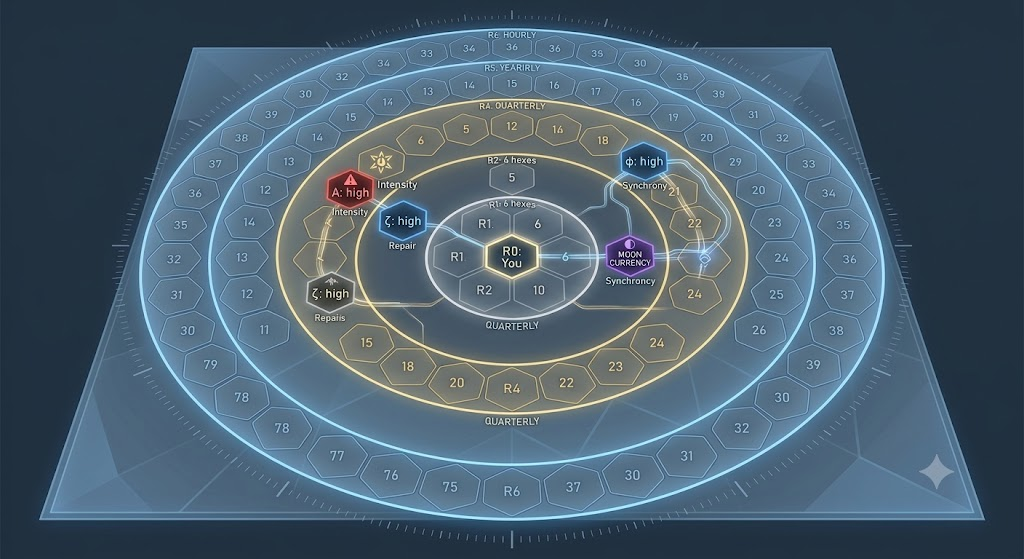
For the practical human layer, V3 uses a qualitative oscillator lens: tempo, intensity, synchrony, and repair burden. These dimensions help describe relational load without pretending to measure a person or relationship with an unvalidated equation.
Read the full foundation
Start with README.md, then continue through the five-field framework, the cosmic-weather extension, evidence and boundaries, and practice and observation.
Continue into the Core Workbook
The Anthrocybernetics Core Workbook turns the foundation into a beginner-readable field manual: five-field practices, capacity and repair protocols, Cascade mapping, nested-system exercises, and cosmic weather revisited with explicit evidence boundaries.
About the Author