Implementation Manual: The Energy Budget Protocol & Thermodynamic Relational Management
1. Strategic Foundation: From Cognitive Limits to Thermodynamic Ceilings
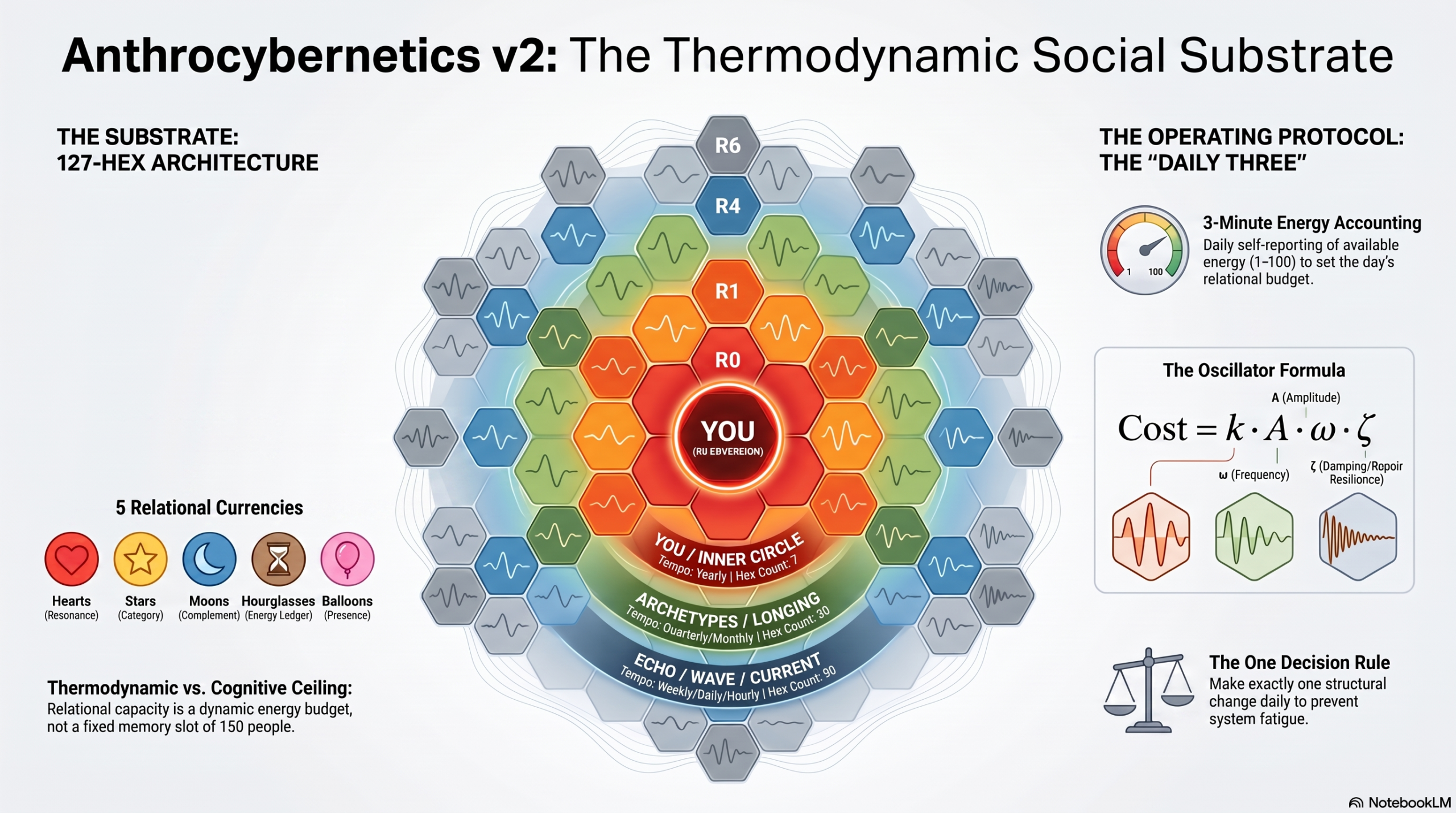
In high-stakes executive performance, the primary constraint on a relational network is rarely the operator’s cognitive ability to index names or faces. The bottleneck is the Thermodynamic Ceiling—the finite reservoir of engagement energy available before the system signal falls below the noise floor. While traditional models rely on the Dunbar-bounded framework (suggesting a fixed neocortical limit of approximately 150 slots), this protocol shifts the architectural focus to active resource allocation. This transition is essential for professionals in environments where “memory” is never the limitation, but “capacity for resonance” is. By conceptualizing relationships as open systems requiring continuous energy input, we move from passive tracking to active thermodynamic systems management.
| Feature | Old Model (Cognitive) | New Model (Thermodynamic) |
| Empirical Foundation | Dunbar’s Number (Neocortical capacity) | Oscillator Model (Thermodynamic energy-bounded) |
| Flexibility | Static (~150 slots) | Dynamic (Varies by life season/depletion) |
| Actionable Outcome | Categorization of “social distance” | Measurable daily resource allocation |
| Constraint Source | Information tracking limits | Real-world energy expenditure/Dissipation |
Central to this architecture is the Sovereign’s Seat (R0). By establishing the self as the irreducible reference point and primary observer-actor, the operator creates an objective baseline for all relational axes. Treating R0 as the non-negotiable anchor prevents subjective “drifting” and emotional volatility. Every relationship on the grid is thus measured by its synchrony and cost relative to this center. This strategic foundation is mapped onto the physical substrate of the protocol: the Cascade Hexgrid.
2. The Substrate: Architecture of the 127-Hex Cascade
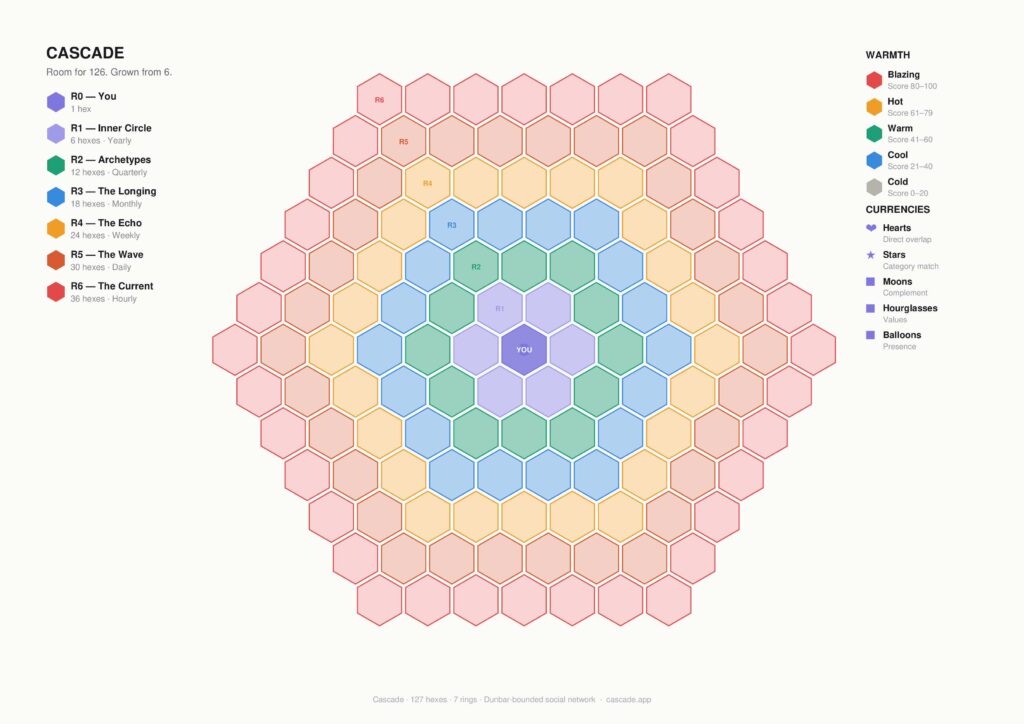
The Cascade Hexgrid serves as the relational substrate for the protocol, utilizing hexagonal close-packing to optimize the modeling of radial phase-locks. Unlike square grids, which introduce diagonal distance distortions, hexagons provide six equidistant neighbors. This ensures that interaction frequency (\omega) operates uniformly across the grid, allowing for a mathematically superior representation of relational proximity.
The grid comprises 7 Rings (R0–R6), totaling 127 hexes (126 relational slots surrounding the central observer):
- R0: You (The Sovereign) – The irreducible reference point; the sovereign observer-actor.
- R1: Inner Circle (Yearly) – Lifelong anchors; the highest stability assets.
- R2: Archetypes (Quarterly) – Role-relationships (mentors, siblings, peers) and formal patterns.
- R3: The Longing (Monthly) – Intentional reach; assets the operator actively seeks to engage.
- R4: The Echo (Weekly) – Consistent presence; voices heard on a weekly cadence.
- R5: The Wave (Daily) – Rhythmic daily engagement and high-tempo routine.
- R6: The Current (Hourly) – Real-time, ambient, and immediate presence.
Relational health is visualized through 5 Warmth Bands, which translate raw energy scores into a qualitative state of “phase-lock.”
| Band | Score Range | Qualitative State |
| Blazing | 80–100 | Highest phase-lock; minimal forcing required for resonance. |
| Hot | 61–79 | Strong resonance; high synchrony and phase-alignment. |
| Warm | 41–60 | Steady state; reciprocal energy flow. |
| Cool | 21–40 | Declining state or just-formed; requires immediate intervention. |
| Cold | 0–20 | Inactive or rupture; primary candidate for “Lethe” (demotion). |
This physical grid provides the structure through which energetic currencies flow, enabling the identification of system-wide asymmetries.
3. Relational Currencies and the Cost Formula
To diagnose network failure, the protocol tracks five distinct currencies. Multi-currency tracking is necessary to distinguish between Resonance (the quality of the coupling) and Cost (the energetic ledger).
- Hearts (❤): Tracks direct overlap and explicit resonance events (messages, meetings). Observable via high-amplitude, high-sync events.
- Stars (★): Tracks category congruence (shared tribe, field, or work context). Observable via phase alignment through shared context.
- Moons (☾): Tracks complementarity—the relationship that “fills the gap” in the operator’s system. Observable via lowered effective damping (\zeta).
- Hourglasses (⧖): The budget currency; tracks the running ledger of energy spent vs. energy received.
- Balloons (🎈): Tracks passive presence and ambient awareness. Observable as low-amplitude, low-frequency presence.
The energetic cost of any single hex is calculated using four Micro-Parameters:
- Frequency (\omega): Interaction rate (how often the system cycles).
- Amplitude (A): Magnitude of oscillation (depth of self-disclosure/intensity).
- Phase (\phi): Timing offset (synchrony and rhythm alignment).
- Damping (\zeta): Resilience and conflict-repair capacity.
The Working Cost Formula: E_{rel} \approx k \cdot A \cdot \omega \cdot \zeta
The k constant (default 0.01) serves as a vital environmental calibration tool. An Architect adjusts k to reflect the overhead friction of the operator’s professional environment. A high-friction corporate culture with heavy administrative tax requires a higher k, while a streamlined, low-friction startup environment allows for a lower k.
Systems Architecture Caveat: Following the Ego-Depletion Replication Crisis (notably Hagger 2016 and Vohs 2021), this protocol rejects the “glucose-as-willpower” physiological model. In this framework, “energy” is a metaphorical scaffold and protocol commitment, not a literal physiological measurement. This distinction is vital for maintaining the “Radical Honesty” required for objective network auditing.
4. Diagnostic Framework: The Four Patterns of Energy Allocation
This framework serves as an audit mirror, moving the professional beyond vague exhaustion toward the identification of systemic budget failure.
- The Saturator (E_{total} \approx E_{available}): A sustainable steady state where the network matches the budget. Growth requires a deliberate surplus.
- The Investor (E_{total} < E_{available}): A state of surplus. The operator is building toward a deeper Cascade. Ideal for professional expansion.
- The Overdrawer (E_{total} > E_{available}): A high-risk deficit state. The operator is depleting reserves, leading to inevitable system-wide thrashing.
- The Throttler (E_{total} \gg E_{available}): Emergency mode. The operator is actively cutting back to return the system to equilibrium.
In high-stakes environments, the Overdrawer pattern is critical. When the system is overdrawn, the amygdala flags this state through “salience-flagging” stress signals. Failure to respond to these signals results in cognitive thrashing and an eventual forced “hard-demotion” of high-value assets to prevent total system collapse. To avoid this, the operator must transition to a stable daily tactical rhythm.
5. The Daily Operating Protocol: The “Daily Three”
The “Daily Three” is a mandatory 3-minute rhythm designed to mitigate decisional fatigue and prevent reactive “thrashing” within the network.
Step 1: Energy Check-in (60 Seconds) Self-report available relational energy as a budget number (1–100 scale).
- 90–100 (Surplus): Capacity for investment or repair.
- 70–89 (Stable): Maintenance mode.
- 50–69 (Cautious): Defend current warmth; consider demotions.
- 30–49 (Depleted): Focus on R1–R2 only; allow outer rings to cool.
- < 30 (Emergency): Survival mode; R1 anchors only.
Step 2: Capacity Check (90 Seconds) Sum the costs of all active hexes (E_{total} = \sum E_{rel}). If E_{total} > E_{available}, the system is in a structural deficit.
Step 3: One Decision (60 Seconds) Execute exactly one structural command based on the E_{total} vs. E_{available} matrix:
- Large Deficit: Demote one R5–R6 hex to Cold (Lethe candidate).
- Specific Rupture: Immediately update the hex’s \zeta to 7–10. If the system is still in deficit, demote.
- Surplus: Promote one hex or invest in deepening a Warm hex.
- Equilibrium: Log as a steady-state day.
This is the “Humility Gate”: limiting the operator to exactly one decision per day provides a safeguard against emotional volatility and ensures that changes are deliberate structural evolutions rather than reactive spasms.
6. The Zeta-Drop Mechanism: Professional Promotion and Maintenance
The Zeta-drop is the causal engine for relationship promotion. Within this protocol, promotion is not a reward for tenure; it is the mathematical result of reaching critical damping (lowered \zeta).
The logic flow is as follows:
- Sustained Phase-sync (\phi) and Amplitude (A) create Resonance.
- Resonance builds a track record of repair, which lowers the Damping (\zeta) or friction.
- As \zeta drops, the relationship becomes more efficient. This allows for a lower minimum forcing frequency (\omega) to maintain the same warmth score.
- The relationship is “promoted” to a slower ring (e.g., R5 Wave to R4 Echo) because it now requires less interaction to remain Blazing or Hot.
Rules of Thumb for \zeta Recalibration:
- Rupture resolved within 24 hours: \zeta remains unchanged.
- Rupture resolved within 2–7 days: \zeta +1.
- Unresolved rupture: \zeta +2 (consider immediate demotion to Lethe).
- One year of consistent successful repair: \zeta -1.
This creates an Objective Decision layer for the operator. When the thermodynamic ceiling is reached, the \zeta values identify which assets have high friction costs. Relationships that refuse to drop in damping are candidates for demotion to make room for more coherent connections.
7. Implementation Failure Modes and Mitigation
The effectiveness of the protocol relies on Radical Honesty in self-reporting and Functional Compression in practice.
Failure Modes:
- Gaming the Budget: Over-reporting energy (E=100) to avoid hard demotion decisions.
- Correction: Third-party facilitator audit and honest assessment of system-wide thrashing symptoms.
- Treating Hexes as Fungible: Viewing people as spreadsheet data rather than real relational assets.
- Correction: Remember that the grid is a map of life, not a replacement; demotion is a real-world act of letting go.
- Decisional Fatigue: Attempting to move multiple hexes in one cycle.
- Correction: Adhere strictly to the Humility Gate (One Decision).
- Ignoring the Dynamic Ceiling: Failing to lower the budget during high-stress projects or illness.
- Correction: Monitor the trajectory of E_{available} rather than isolated snapshots.
About the Author